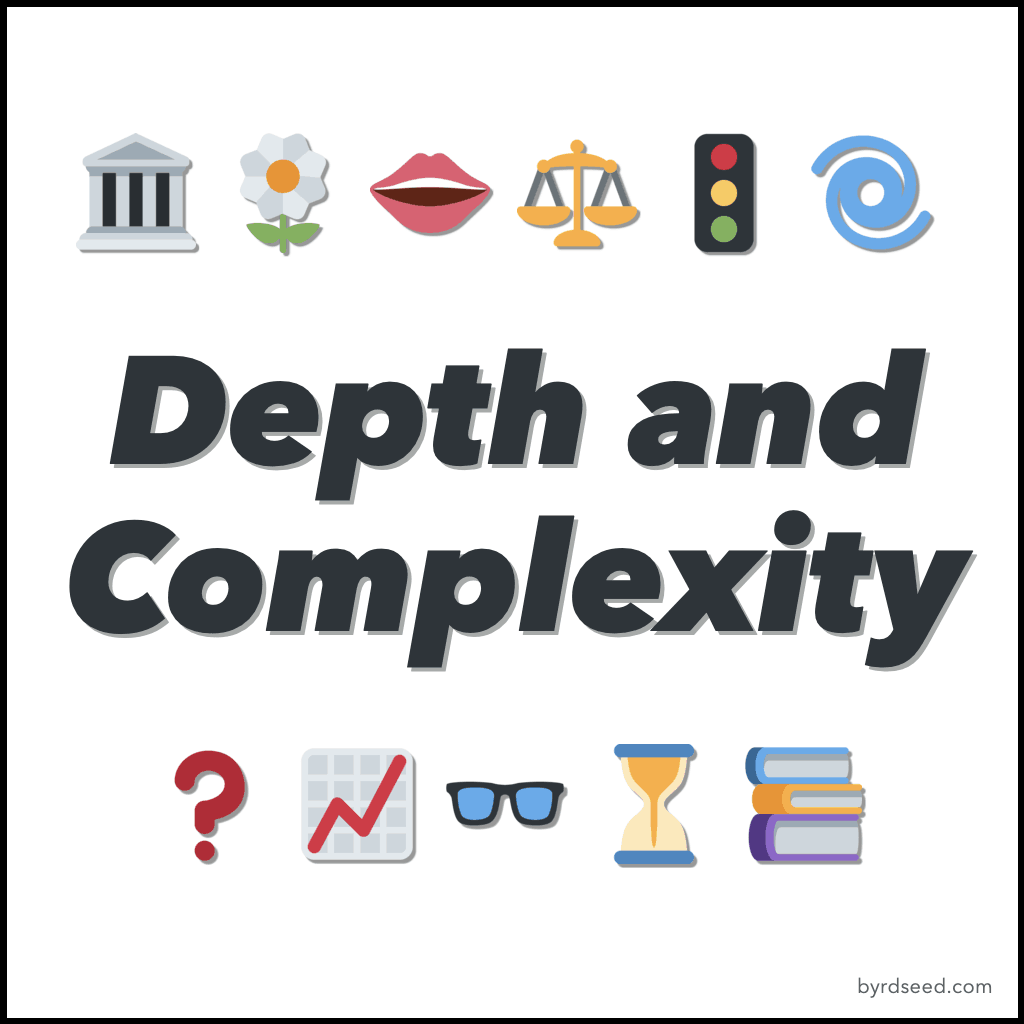
The Depth and Complexity icons are eleven tools that act as lenses, prompting students to look at a topic in a new way. They will help you to take your students deeper into grade-level material rather than moving them onto a new topic.
Sound too good to be true? Read on!
Get It All Via Email
Hey, if this long article is way too long you can take it in more leisurely through the Depth and Complexity Mailer. You’ll get an email every week introducing a couple of the prompts. It’s free!
Get Free Depth and Complexity Ideas
Onward!
Table of Contents
The Back Story
The overarching goal of Depth and Complexity is to move students towards expert knowledge of content. Bette Gould and Sandra Kaplan looked to understand how an expert understands their field differently from a layperson. Through interviews, they saw that these experts knew things like repeating patterns, required rules, ethical dilemmas, changes over time, and essential vocabulary within their field.
They identified eleven of these traits and assigned a name and a symbol to each. The idea is that students can move closer to an expert’s level of understanding by thinking through these same lenses.
A Quick Example
The prompts of Depth and Complexity will sharpen your questions – and your students’ answers.
See the sharpness in action:
- “Compare and contrast Lincoln and Washington”
- “Contrast the ⚖️ ethical dilemmas Lincoln and Washington faced.”
- “Compare the 🚦 rules Lincoln and Washington created as presidents.”
See how broad and vague that first question is? It invites surface-level thinking. Using a prompt of Depth and Complexity raises expectations.
About Those Icons
Each tool is represented by an icon that gives students a visual shortcut to expert thinking. The tools’ icons especially benefit younger students or those learning English. They unlock access to higher levels of thinking than those students’ vocabulary would otherwise support. But their use should not be limited to just those students.
Even as a grownup, I use the icons when I take notes. If I spot an interesting dilemma, I’ll sketch a little ethics icon to call it out. When I see a student draw an icon on their work, I know that they’re calling out a certain way of thinking.
A final note about the graphical icons: beware relying on pretty clip art or professionally designed images. It sets the bar too high. Instead, draw the icons by hand as you teach. Encourage students to do the same. The Depth and Complexity prompts are ultimately students’ tools, and students should feel empowered to use their tools whether they have access to specific clip art or not.
Sidenote: Read about why I use emoji for depth and complexity icons when using devices. They’re free and easily accessible anywhere.
Depth and Complexity Basics
Here are the eleven prompts of Depth and Complexity along with a teeny explanation and a link to full articles.
| Icon | Name | Description |
|---|---|---|
| 🏛️ | Big Idea | An overarching idea about a topic. |
| 🌻 | Essential Details | The most important specifics about a topic. |
| 👄 | Language of the Discipline | The vocabulary an expert would use to discuss their field. |
| 🚦 | Rules | The laws, hierarchies, norms, etc. within a topic. Breaking a rule leads to a consequence. |
| 🌀 | Patterns | Expected repetition within a field. These can break without necessarily creating a problem. |
| ⚖️ | Ethics | The problems, ambiguities, or dilemmas of a topic. |
| ⏳ | Change Over Time | How has a topic changed over long periods of time? |
| 👓 | Multiple Perspectives | How do different people view this topic? |
| ❓ | Unanswered Questions | Perhaps the most under-used of the prompts. It’s so much more than “What questions do you have?” Instead, push students towards what we don’t yet know about this topic. Or whatcan’t we know? Consider questions that are truly unanswered to humankind. |
| 📚 | Across Disciplines | How does this topic represent an intersection of other fields? How do language arts and math appear within this topic? |
| 📈 | Trends | How a topic is currently changing and what forces are causing those changes? Trends is the prompt I’d most like to get rid of. |
So that’s the eleven prompts of Depth and Complexity. Yeah, there are a lot! But there’s no need to use them all at first. Get comfy with, like, four. Plus, you’ll be surprised how quickly you start to pick them up.
Want to get a series of emails explaining each Depth and Complexity prompt? Sign up for free here!
The Biggest Problem with Depth and Complexity
Without a doubt, the biggest problem people make with Depth and Complexity is: pairing an icon with a low level of Bloom’s Taxonomy.
Look at these three tasks and think about what the level of thinking that each requires:
- Identify the rules in this math problem.
- List the important details about George Washington.
- What are the patterns in the solar system?
Do you see it? ☝️ Every one of those questions requires merely a list as an answer. Even though I might be taking the content deeper, I’m still asking super low-level questions. I’m at the bottom of Bloom’s – despite using depth and complexity.
And, now that I’m aware of it, I see it everywhere. Do a search for “depth and complexity worksheets” and spot all of the low-level questions out there. It’s almost impossible to find any examples where the icons paired with high levels of Bloom’s Taxonomy.
So please make sure to pair depth and complexity with high levels of thinking:
- Compare/Contrast: How is Poe’s 👄 language different from Lewis Carrol’s?
- Evaluate: Which author most effectively uses 👄 language to create their tone?
- Synthesize: What would happen to the tone if we used some of Carrol’s 👄language in The Raven.
See how we can go beyond “list the vocabulary words” and really get kids thinking?
Depth and Complexity Resources
Ok! Let’s take a break here and I’ll point you to a few Depth and Complexity resources that I’ve had a hand in creating:
- Get free Depth and Complexity emails which are very free and very good.
- Grab my Depth and Complexity PDF
- Check out student videos for each prompt at Byrdseed.TV.
- Or, enjoy these videos for teachers.
If you’d like to continue on, I have an article about how to introduce depth and complexity to students.