
Deep down, we know that everyone possesses creativity, yet this quality seems so elusive. Some kids do just seem to jump into creative tasks while others flounder.
Can we teach students to be creative? Can we practice it as a skill?
The Torrance Tests
The Torrance Tests of Creativity Thinking were developed by Ellis Paul Torrance to test levels of creativity.
He deconstructed creativity into measurable dimensions. I think three of these dimensions are quite useful for quick “creativity practices” in the classroom:
- Fluency: how many ideas can a student generate
- Elaboration: how detailed are the ideas
- Originality: how many of the ideas are unusual or uncommon
Practice
Armed with three measurable dimensions of creativity, we can build creativity exercises into the day.
They help build students’ confidence in their creativity. And they reverse the “one-right answer” mentality often present in schools.
Vocabulary Games
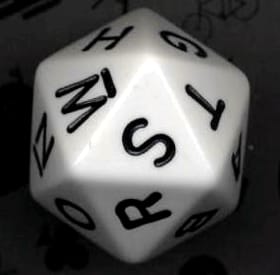
This idea is based on Scattergories.
- Pick a random letter (the game comes with an awesome letter dice),
- Pick a category.
- Students brainstorm items that fit the requirements.
For example, the letter “C” and “fruits and vegetables.”
Let’s look at how to use this idea to practice each the three dimensions of creativity:
Fluency Give students thirty seconds to brainstorm. Count up how many ideas they created.
Ask students to share examples they were uncertain about. Maybe someone wrote cauliflower but was uncertain if it’s really a vegetable.
Your own reaction to their uncertainty will help establish whether your classroom truly values creativity. Aim to help students become comfortable with taking risks being comfortable with uncertainty.
Originality To measure originality, count the “unusual” answers students generated. “Carrot” might be very common, but I’ll bet very few students would list “celtuce.” If only one person in the group listed something, it would count as a unique answer.
Elaboration Students pick one response. Then they generate as detailed a paragraph as possible in a minute. Perhaps a student picks “cress” and develops an elaborate story. Encourage students to go deep into details despite their limited time.
A Drawing Game
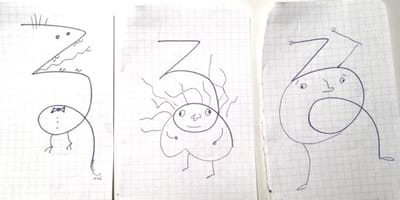
I’ve made a bunch of these at Byrdseed.TV.
In 5th grade, my class played a drawing game on a chalkboard.
- A lucky student carefully drew three identical squiggles on the board.
- They stood outside.
- Three new students went up and added to the squiggles.
- When time was up, there were three remarkably different drawings on the board.
- The original squiggle-drawer came back in. After careful consideration, they selected their favorite adaptation of the original squiggle.
- The creator of the winning drawing then got to make the next set of squiggles.
Let’s adapt this game as a creativity exercise. Individual whiteboards would be great to keep everyone involved.
- Fluency: Everyone gets the same squiggle and generates as many ideas as possible.
- Originality: Students aim for the most unusual drawing using the same squiggle.
- Elaboration: Students cram as much detail as possible into a single adaptation of the squiggle.
There’s a reason I vividly remember this game: it’s a blast and, if we aim it carefully, it’s prefect for building students’ confidence in their creativity.
Alternative Uses Task
We have a bunch of these at Byrdseed.TV too!
The alternative uses task is hilarious. Students think up unusual uses of common items. Given “chair,” start a timer and ask students to create as many “alternative uses” as possible. A chair could be used as a:
- doorstop
- step-stool
- hat
It’s simple to adapt these tasks to practice fluency, elaboration, and originality.