
During Christmas, my younger sister received more gifts than me. Sensitive to this, my parents explained that my video games and Lego, although small, cost far more than the type of gifts she liked. They assured me that they spent an equal amount of money on us both.
This got me thinking: as a holiday math project, let’s analyze the relationship between sizes of gifts and their prices.
As usual, the data’s already waiting for us, this time on Amazon.com.
I’ve put together a spreadsheet for you to use or download as an Excel file (I think you lose the images though). Calculations are already included. Of course, you may choose a completely different set of toys if you’d like.
The Opening
As an opening question, ask students which is worth more: Thomas or this outdoor slide set?
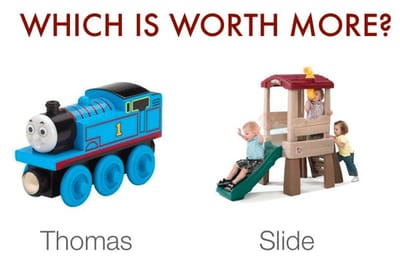
Students might ask for clarification: how big are they? This is a perfect opening to discuss the relationship between price and size.
- Are big toys always more expensive?
- Are there some big gifts that are cheaper for their size?
- How can we measure this?
We’re going to think like an aunt or uncle who really wants to impress their nieces and nephews, but doesn’t want to overspend. We’re looking to maximize size and minimize price.
My Four Goals
The four characteristics I look for when developing a math project are:
- Authentic Data: From Amazon.com
- Conflict: What’s the cheapest, largest gift I can buy?
- Perspective: Cool aunt or uncle (on a budget).
- Product: brochure, presentation, website, etc
Price Per Cubic Inch
We’re trying to find out how much we’re paying for the size of a toy. There are two steps to determine this. For each toy, we’ll:
- Calculate volume.
- Determine price per cubic inch using ratios.
Here’s the calculations for the slide and Thomas:
| Item | Price | Volume | $ / cubic inch |
|---|---|---|---|
| Outdoor Slide | $160 | 95,000 in3 | $0.002/in3 |
| Thomas Toy | $13 | 25 in3 | $0.50/in3 |
Sure, the slide may be $160 dollars, but measured in dollars per cubic inch, Thomas is 250 times more expensive! Not a great choice for the aunt and uncle looking to maximize size and minimize price!
Getting The Data
If you have access to computers, students can dig up dimensions, price, and weight on Amazon.com. If not, print and copy this sheet or modify the Excel file.
Disclaimer: Prices will probably change a bit, and I used regular rather than sale prices.
Then, have students determine price per cubic inch for the remaining toys. You can group kids up, collaborate as a class, or assign this individually.
Graphing
Students should graph their data to identify patterns. Here’s a scatter plot showing total price compared to $/in3.
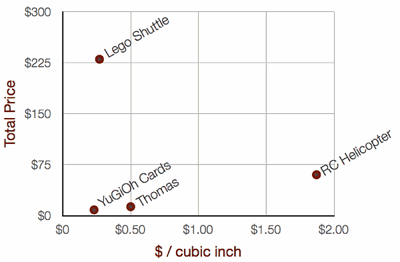
Immediately I note that the expensive Lego Imperial Shuttle is actually pretty cheap based on its size, especially compared to the RC Helicopter. The Yu-Gi-Oh cards are quite inexpensive in both dimensions.
Product
Finally, students create products to recommend, and explain the math behind, their top choices for those looking to secure the title of “cool aunts and uncles.” Possibilities include:
- Presentations
- Brochures
- Websites
Extensions
You could also:
- incorporate proportions to calculate how large or small a toy would have to be to match the price of another toy
- have students bring in their own toys to measure
- investigate price per pound
- take surveys to determine a preference for cheap/heavy toys
- teach kids to use spreadsheets to calculate tons of data quickly