So much of our writing time is spent correcting details of grammar that we neglect the larger picture in writing. This article introduces a writing unit about large patterns common to great story writing.
“Structure Increases Creativity”
We’ll frame this unit with the generalization: 🏛️ “Structure increases creativity.” A generalization is an abstract statement applicable across many disciplines.
If you’re new to the use of abstract generalizations, this is a way to get students thinking BIG! Approaching writing from whole to part using an abstract generalization is aligned with the needs of gifted learners.
Introducing The Big Idea
The opening lesson of this unit will simply explore the idea that “Structure increases creativity.” We’re teaching our students that this generalization is applicable across many disciplines.
Here’s an excerpt from a Wired article I used as inspiration:
…consider these cultural and technological high points of the last century: Piet Mondrian helped usher in modernism by limiting himself to 90-degree angles and primary colors. Miles Davis conceived Kind of Blue (a modal jazz masterpiece) without using the complex chord changes that were popular in jazz. More recently, the very iPhone on which you listen to Davis’ landmark album is a one-buttoned example of restraint in pursuit of an ideal…
From Wired.com
I begin by brainstorming as many examples as possible from multiple disciplines. The Wired article is a great starting place, but my own experiences and my students’ lives will be the most useful resource.
Some possible examples:
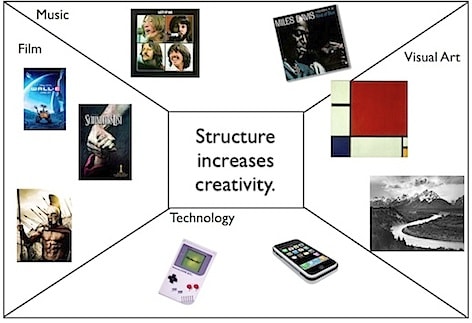
- The Beatles limited their instrumentation on Let It Be
- Ansel Adams used black & white film to photograph nature.
- Pixar chose to use minimal dialog in Wall•E.
- If age-appropriate, note that films such as Psycho, Schindler’s List, 300, and Sin City were purposefully filmed in black & white or a very limited color palette.
- The Game Boy boasted a black and white screen and two buttons, yet defeated all competitors.
- Shakespeare utilized iambic pentameter in much of his writing.
However, I also want my class to bring their own ideas in. Open up the brainstorming to them and you’ll be surprised at what they come up with.
Frame The Theme
As a class, we use these examples to construct a frame to group these examples according to their discipline.
Group Work
Split students up into groups, hand them an image such as the following, and ask them to explain how the example supports our big idea. I would print out images such as the following and hand one to each group.


(These images include art from Picasso and Escher, a poster of The Nightmare Before Christmas, an excerpt from Yertle The Turtle, and a picture of iPods. )
Extend – Independent Practice
To extend this idea and increase the rigor, I’ll ask students to create a short (very short) story that follows a strict structure. Ideas could include:
- Employing iambic pentameter
- Writing a six-word story
- Using words of only a certain length
Coming Next…
After getting students thinking about the various ways that structure, rules, and patterns can lead to creativity, I bring in our true content, which is writing.
Writers use structure and patterns as a base on which they build their creativity.
The types of patterns we’ll examine in this unit will include:
- The five-act dramatic structure
- Recurring Themes
- Character archetypes
- Types of conflict
In the next lesson, we’ll begin digging into the patterns of plot structure.