Thinking Like Producers About Consumers Here's how I'd use ethics and multiple perspectives to get students thinking about producers, consumers, and decomposers in new and interesting ways.
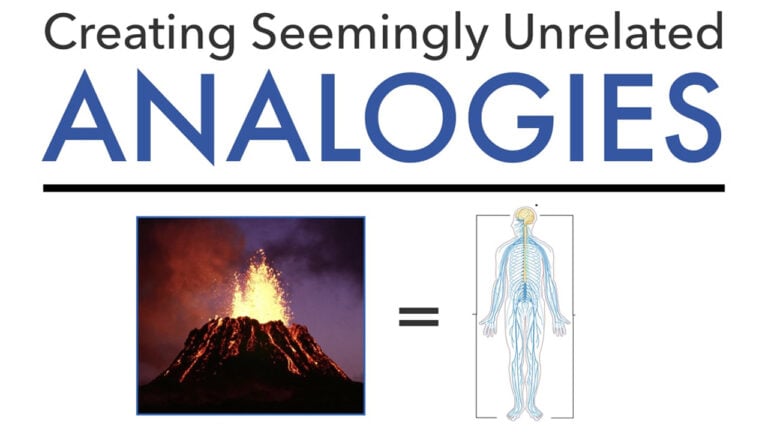
Creating Seemingly Unrelated Analogies Want to encourage students to find unexpected connections across content? Here's a quick framework based on the most important terms from both bits of content.
Help my students remember these confusing terms! If you want students to memorize, you can't aim for memorize. You have to aim higher – and then memorization comes along for free.
Lunar Survival Skills We're supposed to rank fifteen items according to usefulness if we were stranded on the light-side of the moon. The items range from pistols to powdered milk. Some seem useful, but are actually worthless while others seem unnecessary on earth, but are actually vital when stuck on the moon. However, the structure of the activity as a website is not optimal. Let's improve this and make it an awesome problem–solving exercise for our class.
Upgrading A Research Report So many "research reports" are really just "regurgitation re-writes." Here's one way to take a research report to a much more interesting level.
Updating Old Questions: A Mere Model of a Cell Why are my best biologists just restating facts we already know?
Taking Flashcards Up To “Analyze” We had a pack of animal flashcards. But my kid can already read. So here's how we took these low-level cards up to Analyze – in three different ways.
Updating Old Questions: The Planets’ Order Oops! I just asked my students to put the planets in order! Here's what I could do differently…
Pop Quiz! Rock Cycle Depth and Complexity Here are a set of questions someone sent in. What do you think?
Climbing Blooms With A Science Lesson How I'd push a mere science demonstration to higher level of Bloom's Taxonomy.