
I read something surprising about Norway and the Winter Olympics.
With only five million people, it has won 303 winter Olympic medals, far more than any other country on the planet…
How Norway Scores So Much Olympic Gold, Wall Street Journal
That contrast grabbed my attention. I love when numbers don’t match what we expect. That’s the perfect start for a math project.
If you want, you can skip the rest and just use the finished version at Byrdseed.TV!
Four Tips for a Math Project
When I build a math project, I include four things. They help take a project from good to great:
- Authentic Data
- An Intriguing Conflict in the Data
- An Expert’s Perspective
- A Creative Product Based on the Expert
The Wall Street Journal article gives us a great conflict right away:
- Should we rank Olympic success by medals alone… or by medals compared to population?
- Does it matter more how big a country is by people or by land area?
- Which countries do better in summer vs. winter Olympics?
- What happens if we compare medals to other data, like GDP or quality of life?
Suddenly, the Olympics become a giant math playground.
Authentic Data
The internet has everything we need:
- Wikipedia has an excellent all-time Olympic medal table.
- Here are lists of countries by population or by area.
- You could also explore gross domestic product or the human development index.
Do wealthier countries win more medals? Do smaller countries sometimes outperform everyone?
Curriculum Connections
You can use this data in lots of ways, depending on your students’ ability.
Younger students can:
- work with large numbers by ordering, adding, or subtracting
- make simple bar graphs
Older students can:
- explore ratios
- build scatter plots
- think about scale, outliers, and patterns
And everyone should be asking:
What do these numbers reveal?
A bonus idea: students can use spreadsheets to do the calculations and graphing. That shifts the work away from tedious arithmetic and toward real analysis.
Expert Perspective
This is really a statistics project.
Students can take on the role of statisticians, looking for hidden patterns in the data.
A statistician’s main tool is simple:
- organize the numbers
- graph them
- explain what they notice
The final product could be a set of graphs plus a short written response:
What patterns did you uncover?
Graphing Samples
Here are a few examples to get started.
Total Medals vs. Population
| Country Name | Total Medals | Population (millions) |
|---|---|---|
| Great Britain | 802 | 63 |
| France | 765 | 66 |
| Norway | 451 | 5 |
| Japan | 435 | 127 |
| Canada | 423 | 35 |
| South Korea | 288 | 50 |
| Austria | 287 | 9 |
| Brazil | 108 | 220 |
| New Zealand | 100 | 5 |
This scatterplot compares total Olympic medals vs. population in millions using nine countries.
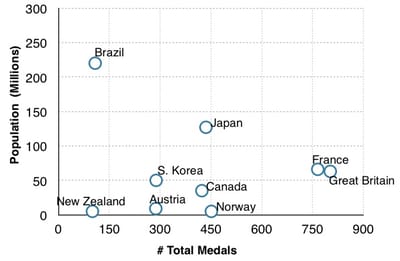
The fun part is what shows up once the data is graphed:
- France and Great Britain end up as medal neighbors, not just geographic neighbors
- Brazil and New Zealand have almost the same medal count, even though their populations are wildly different
- Norway, Austria, and New Zealand have similar populations, but very different medal totals
- Japan sits in a sweet spot between population size and medal count
Graphing makes these patterns visible.
Winter vs. Summer
| Country Name | Winter Medals | Summer Medals |
|---|---|---|
| Great Britain | 22 | 780 |
| France | 94 | 671 |
| Japan | 37 | 398 |
| Canada | 145 | 278 |
| South Korea | 45 | 243 |
| Norway | 303 | 148 |
| Brazil | 0 | 108 |
| New Zealand | 1 | 99 |
| Austria | 201 | 86 |
I also graphed summer vs. winter totals and overlaid a rough “temperature gradient” to show each country’s seasonal dominance:
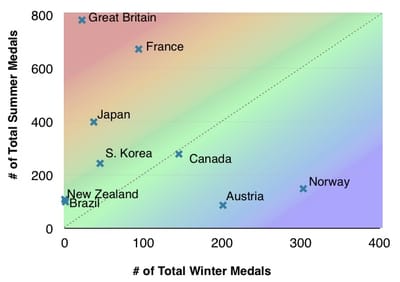
Some quick takeaways:
- Canada is surprisingly balanced
- Great Britain and France lean heavily toward summer
- Norway and Austria dominate winter
- Brazil and New Zealand have almost identical winter/summer ratios
Ratios
Older students can go one step further and calculate something like:
medals per million people
| Country Name | Ratio (medals per million) |
|---|---|
| Great Britain | 12.8 |
| France | 11.6 |
| Norway | 90.2 |
| Japan | 3.4 |
| Canada | 12.1 |
| South Korea | 5.8 |
| Austria | 31.9 |
| Brazil | 0.5 |
| New Zealand | 20.0 |
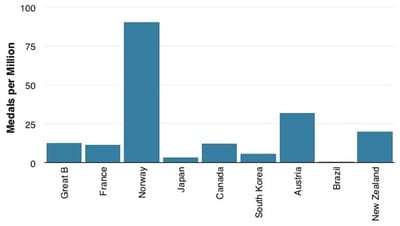
Some observations:
- Norway’s population is small, but its medal total is enormous
- Brazil has a large population and very few medals
- Great Britain, France, and Canada end up with very similar ratios
- New Zealand looks much stronger once population is included
And yes—these ratios are worth graphing too.
On Choosing Countries
It’s fun to let students choose their own countries (ten or fewer works well).
Just be careful with huge countries like the US, China, or India. Their numbers can overwhelm the scale of the graph.
Unless, of course, that’s the lesson!