“This website is my sub plans.” ~ a teacher describing Byrdseed.TV
Your class will become a wonderland of imaginary creates with Greek and Latin names.
Blow up a paragraph into individual sentences. Now reassemble it. The clues hiding in each sentence will surprise you.
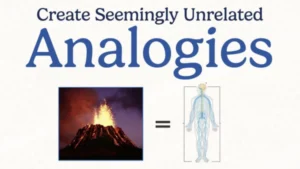
We’ll take two seemingly unrelated pieces of content (say volcanoes and the human body) and then build analogies to connect the two ideas. In the end, students can create a skit, comic, or story relating the two concepts.
We tell students to ‘show, not tell’ — but that advice is useless until they experience the difference. This lesson makes it click.
‘Add more variety!’ teachers say. But how? This lesson gives students actual techniques instead of vague advice.
What happens when Greek and Latin roots become magic spells?
A river that chases, chuckles, and grips things with a gurgle. Your students will see how a writer turns plain water into a living creature, then try it themselves on fire, snow, or traffic.
Your 1st and 2nd graders will analyze how a character responded to a challenge.
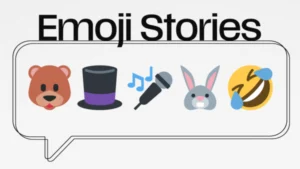
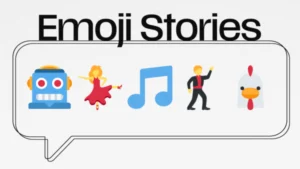
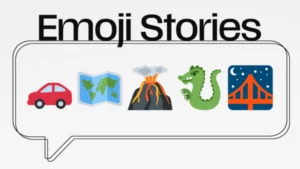
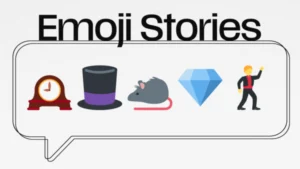
Five emoji. One story. Where will your imagination take you?
Put a grumpy character next to a joyful one and they make each other stand out even more. Opposites are powerful!
How many different ways can we use the word “care”? Let’s find out in this Parts of Speech Party!
Five idioms related to food.
Your youngest students will learn to write Japanese Haiku poetry.
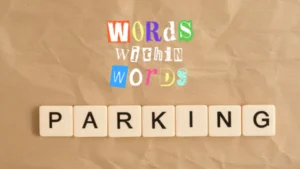
How many words can you find within PARKING?
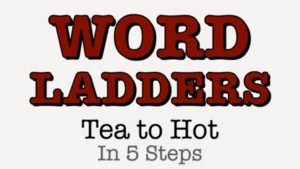
COLD to COOL. BAND to SING. Change one letter at a time — can you find the path?
In a sentence, punctuation may seem meek when compared to those mighty words, but punctuation has incredible power over the meaning of a sentence. Students will try re-punctuating sentences to find new meanings – without changing a single word!
What on earth is a Plexidemokinesis? Break apart the Greek and Latin roots, figure out what it should mean, then invent what it describes.
Pi can go beyond circles! What if you wrote using the digits of pi as your guide?
Add a letter at each step to form a new word. Can you connect the starting point and ending point?
Students use 12 random phrases to create a story that takes place at the zoo.
Ready to push kids beyond the boring, old ABAB rhyme scheme and into something a bit more complex?
Dust can mean “remove dust” but also “add more dust!”
We’ll show students how to add more variety to their writing by starting sentences with a reason, a prepositional phrase, and a simile.
Starting with specific examples of fantastic classroom behavior, your class will end up with one sentence summing up their expectations. It’s a classroom motto!
Can you use the context clues to get these sentences about the coral reef back into the correct order?
Imagine being a character in a story. Are you worried that your story’s narrator may inaccurately describe you? What if they reveal something you wanted to be kept secret? Do narrators have too much power!?
Can someone do the right thing, but for the wrong reason?
How many words can you find within rainbow?
How many words can you find within “scarecrow”?
What if your students rewrote Dickens in the style of Hemingway and vice versa?
Five idioms related to water.
One painting of a bridge. Three robots. Who wrote it best?
What if Kylo Ren wrote a love letter to Abe Lincoln or the Sahara Desert wrote one to the Moon?
Let’s help William Shakespeare with his use of repetition.
Add a letter at each step to form a new word. Can you connect T and PLANET?
A passage from The Jungle Book to use as a mentor text, discussion starter, or writing prompt.
Your students’ sentences all start the same way. Here are three techniques that fix that overnight.