“Everything is so linear, but this makes me think diagonally!” ~ a student describing Byrdseed
Can your students spot the run-on sentences?
How many different ways can we use the word “care”? Let’s find out in this Parts of Speech Party!
Plural nouns in English are deliciously fascinating. Yet most plural lessons are so dull! In this experience, students are given a pile of plurals and then inductively create groups and pull out rules and patterns.
How many different ways can we use the word “limit”? Let’s find out in this Parts of Speech Party!
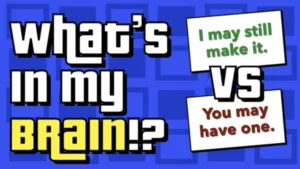
The word “may” can be used for possibility or permission. It’s a modal auxiliary verb!
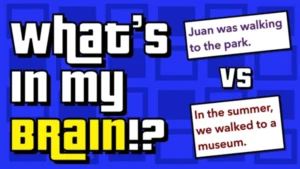
We’re looking at the past progressive tense and the simple past tense.
Can your students spot simple sentences vs compound sentences?
Can your class spot the complex sentences vs compound sentences?
How many different ways can we use the word “fruit”? Let’s find out in this Parts of Speech Party!
Which part of speech is most useful? Interesting? Strange?
How many different ways can we use the word “thanks”? Let’s find out in this Parts of Speech Party!
What happens when a pronoun could refer to more than one noun? Big problems!
Let’s spice up a typically dull lesson about the difference between “its” and “it’s” by asking students to write a children’s story about the adventures of a critter named It.
These clauses are sorted into two groups. What’s the rule? No definitions given — just examples.
Can students spot similes vs metaphors?
Students work with subjects, predicates, and conjunctions to write compound sentences.
What happens when we switch out a “but” with a “so”? An “and” with a “for”? How can such tiny words make such big differences?
How many different ways can we use the word “gift” in a single paragraph? Let’s find out in this Parts of Speech Party!
What exactly does adding -en to a word do? Find the pattern. Then find the words that break it.
What exactly does adding -less do to a word?
Two columns of sentences. Something is different about them. Can you figure out the rule?
Let’s go beyond merely memorizing word parts and instead analyze across languages. How do other languages make a word the opposite?
How many ways can we use “check” in a paragraph? And can your students spot when it’s a verb, or a noun, or an adjective?
How many different ways can we use the word “change”? Let’s find out in this Parts of Speech Party!
Will your students notice progressive tense vs simple tense?
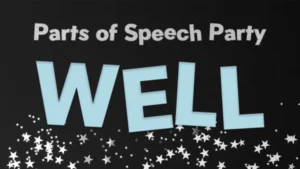
How many different ways can we use the word “well”? Let’s find out in this Parts of Speech Party!